Custom Web App & Booking System Case Study for Lawa Longevity
This case study shows how a custom web app and booking system was built for Lawa Longevity to support complex workflows, multiple user roles, and full data ownership.
This project started as a booking system, but quickly turned into something much more complex. Ultimately, we built a custom web app that functions as a full operational command center. By shifting from a templated tool to a custom platform, we reduced operational risk, saved staff time, and unlocked a foundation for scale.
The Challenge Outgrowing Off-the-Shelf Booking Software
Lawa Longevity needed a robust booking system, but their internal workflows were not simple.
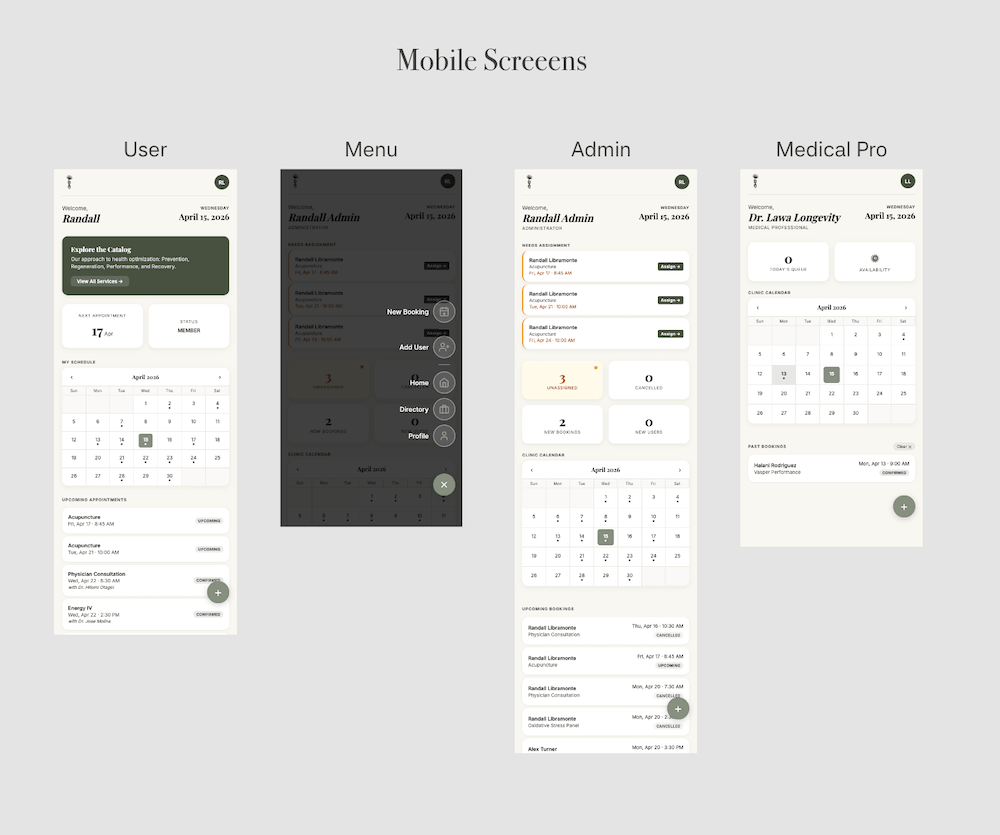
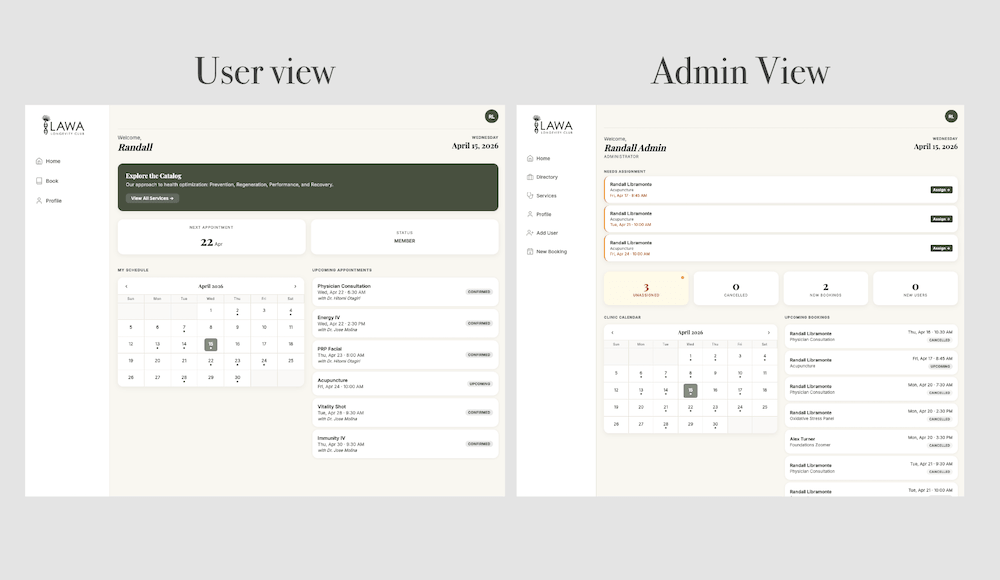
Multiple user roles required specific access: clients, Medical Professionals, and admins.
Conditional booking logic depended on dynamic availability and service rules.
Future scale required planning for memberships, secure payments, and medical-related workflows.
At first, the team explored a third-party SaaS solution, Glofox. On the surface, it worked. It launched quickly to the iOS app store and provided a basic booking flow. The limitations of templated software quickly started to show:
The user experience felt generic and disconnected from the brand.
Workflows did not reflect how the business actually operated day-to-day.
There was no real architectural support for custom logic or edge cases.
A simple, off-the-shelf booking system works perfectly for simple businesses like haircuts or predictable 1-to-1 services. Lawa is not that. When you introduce medical considerations, varied staff roles, and conditional services, the software requirements become complex by default. Forcing a complex business into a templated product creates operational risk.
The Solution A Custom Web App and Operational Dashboard
We shifted direction and built a custom web application from the ground up to support their entire workflow. We established three non-negotiable architectural directives:
Full data ownership to protect client privacy and business intelligence.
Flexible software architecture that adapts to growth without expensive rebuilds.
Role-based workflows that speed up staff tasks and reduce manual errors.
Project Goals We anchored the build around four strict operational objectives:
Launch a working MVP quickly to handle account creation and booking.
Support multiple user roles securely without overlap, data leaks, or confusion.
Prevent common scheduling software issues, like double bookings or ghost appointments.
Create a scalable foundation for future enterprise features (memberships, payments, CRM).
Development Wild Cards Like most real-world software projects, we had to engineer around several real-time constraints:
A tight timeline for MVP delivery.
Business logic and requirements evolving during active development.
Medical-related constraints that strictly influenced how user data was handled.
We originally planned for native mobile development using React Native, but shifted to a web application to move faster and iterate in real time. Because we were already using a React-based architecture, we seamlessly transitioned our components to the web. Coupled with a mobile-first UI design, this pivot accelerated delivery without compromising the client experience.
Software Strategy
At a glance, this looked like a standard scheduling app. In reality, it was an operational system with scheduling as just one component. Our architectural approach was dictated by three operational realities:
Multiple roles interacting with the same data (Clients, Medical Professionals, Admins).
Rules that change based on context (Dynamic availability, staff scheduling overrides).
Future expansion already known (Memberships, payments, CRM integration).
If you ignore these realities early in the development lifecycle—assuming everyone is a generic "user" or treating future scale as a "later problem"—you inevitably hit a structural wall.
“Why build custom when a SaaS stack gets you 80% there in a week?”
For many businesses, that’s the right call. A booking tool, CRM, and automations can validate an idea quickly and at low cost. For a typical consulting business, we would recommend that approach.
Lawa Longevity is different. Their operations involve medical-related client data, intake forms, and clinical scheduling. Passing that across multiple third-party tools and webhooks introduces real risk. When data privacy matters, fragmentation is a liability. As volume grows, so does the strain. Systems fall out of sync. Cancellations don’t match refunds. Teams step in to manually fix gaps. Data splits across tools, logic gets duplicated, and reporting becomes harder to trust. We avoided that tradeoff and built a single, secure system from the start.
We designed the system before adding features. That decision set the foundation for everything that followed:
One single source of truth for operational data.
Strict permissions outlining who can see and modify data.
Complex logic handled securely at the backend system level, eliminating manual cleanup and reducing operational risk.
Custom System Design & Architecture
Role-Based Access Control (RBAC) We segmented the architecture into three isolated user environments:
Medical Professionals: Direct control over schedules and streamlined visibility into their assigned bookings.
Admins: Full, top-down visibility over all activity and global override capabilities.
Each role operates differently. Forcing them into one workflow introduces risk. Isolating them at the database and architecture level removes that friction before it starts.
Data Control and Security Boundaries Because of the medical context, not all data should live in one database. We engineered a hard separation between operational and clinical data:
Operational and booking data lives inside our custom web app.
Sensitive medical data remains in external, strictly compliant healthcare systems.
This hybrid approach keeps the web app fast and highly usable while respecting the strict regulatory constraints of medical businesses.
Core Features, What Users See
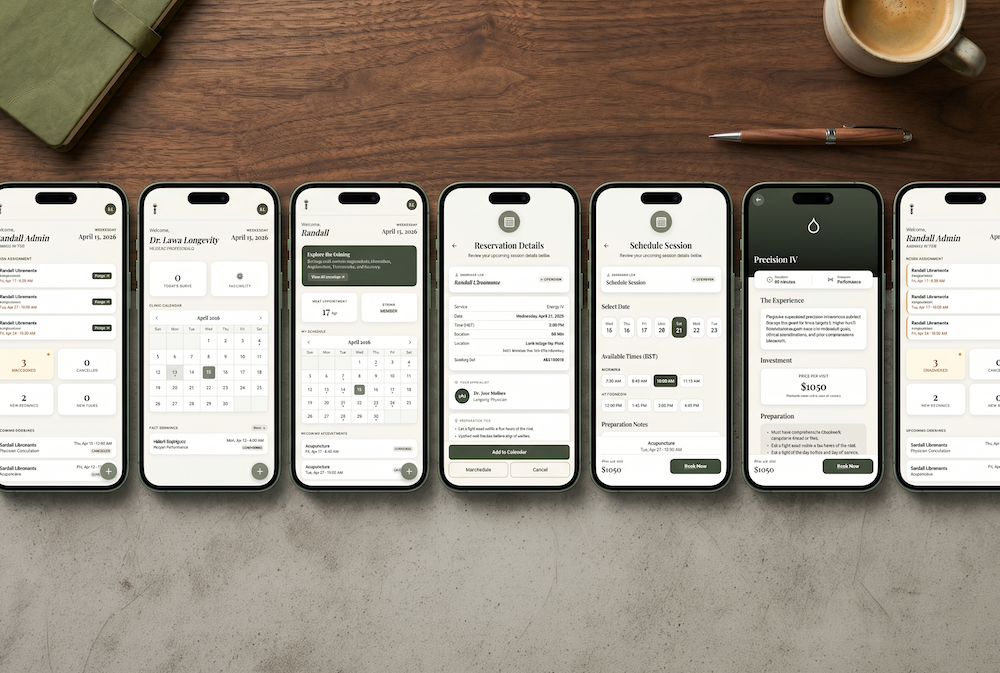
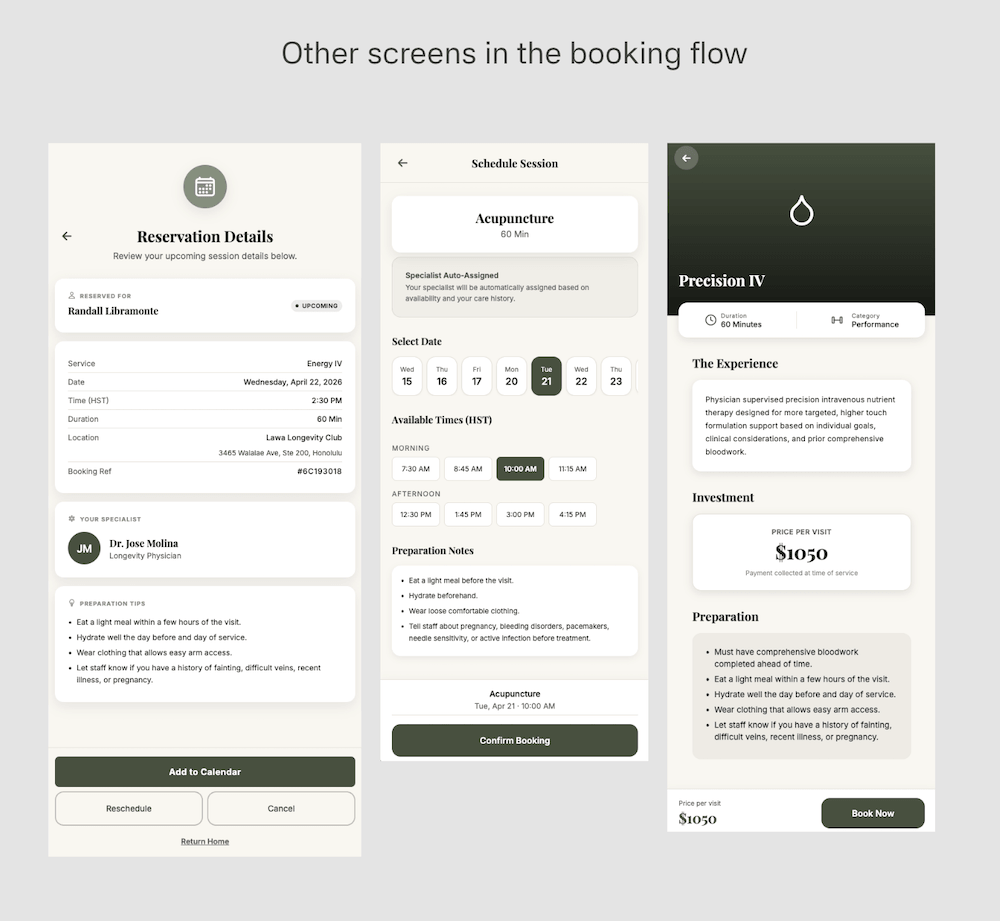
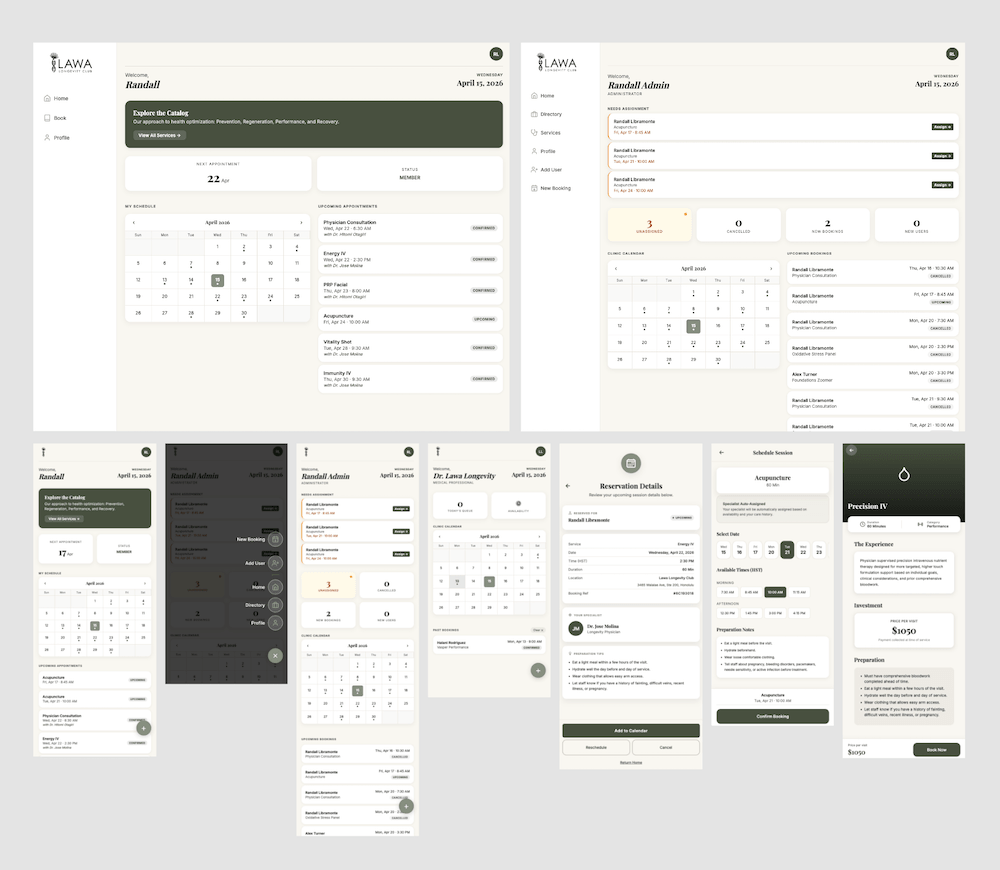
The Frictionless Booking Flow We built an end-to-end booking flow that feels effortless for the client while handling real-time availability checks, role permissions, and scheduling conflicts behind the scenes. Clean, minimal, mobile-responsive layouts prioritize clarity over density.
Medical Professional & Admin Scheduling Interface Staff members need to work fast. Early versions of the scheduling interface exposed too much global data to Medical Professionals, which slowed them down. We refined the views to only show relevant, role-specific bookings, stripping away irrelevant user data. This real-world iteration made the interface significantly faster to use in practice.
What Breaks Most Booking Systems
This is where many standard tools begin to struggle. Most templates handle the "happy path" well, but face issues when real-world human behavior is introduced.
The problem shows up when two people try to book the same time slot at the exact same moment. We engineered concurrency controls directly into the database:
Availability is strictly validated at the exact millisecond of booking.
The system queries the current state of the database, ignoring cached assumptions.
Overlaps are blocked before they happen, eliminating the need for staff to untangle double-bookings.
With multiple user types acting simultaneously, conflicts are guaranteed (e.g., an Admin booking on behalf of a client while a Medical Professional alters their shift). We prioritized data integrity over sheer convenience by validating every single action before a database write occurs. The system blocks invalid states instantly, favoring absolute accuracy over the illusion of flexibility.
AI + Engineering Approach
This is a key technical differentiator in how this custom platform was built.
We utilized AI to accelerate development, quickly scaffolding boilerplate code and generating foundational logic. However, AI does not naturally understand unique business contexts or anticipate complex operational edge cases. It is remarkably easy today to build an application that looks fantastic in a prototype and feels modern on day one. But without underlying architectural experience and real-life user testing, those applications often lack the complex logic and structural failsafes needed to safely guide users end-to-end.
The database schema, the API logic, and the technical tradeoffs made on this project came from human engineering judgment. We leveraged AI for velocity, but relied on core software architecture principles for resilience and security. Without that human engineering layer, the system would not hold up under the weight of real operational use.
Business Impact
The result is a custom system that matches how the business operates today, equipped with the structural integrity to scale tomorrow.
As an early-stage deployment, long-term usage data is still compounding, but immediate structural improvements have completely shifted day-to-day operations:
Reclaimed staff hours: Administrative time previously spent manually untangling schedule conflicts is now redirected to actual operations and client management.
Eliminated the need for staff to manually resolve overlapping bookings through system-level validation.
Faster workflows: Booking behavior is consistent across all roles, reducing friction and confusion between staff and clients.
This shift to full data ownership created three immediate business advantages:
Zero dependency on a third-party SaaS platform's shifting roadmap.
No escalating recurring platform fees tied to core business functionality.
Full, unhindered API access to user activity and historical booking data.
Instead of guessing based on locked-down third-party analytics, the executive team can query and analyze raw usage data to make business decisions.
The initial direction with Glofox offered speed but limited control. But the custom web app we built established full ownership over workflows and alignment with internal operations, while creating a platform built to grow with the business. It expanded the system’s capacity from a fixed tool to a scalable foundation.
Final Takeaways
This project shows when custom web app development makes sense—and when it doesn’t.
Custom development isn't always the right move. If your operational process is highly standardized, a template SaaS tool is often enough. But custom infrastructure transitions from a luxury to a business imperative when:
Your daily operations rely on multiple user roles with varying permissions.
Your service workflows depend on highly conditional logic.
You expect your digital ecosystem to evolve, and you can't afford to be bottlenecked by a third-party vendor.
If your team is constantly fixing scheduling issues manually, or if your current tools dictate how you run your business rather than the other way around, it may be time for a change. Look at who uses your system, what they need to do, and where things are breaking or slowing your team down.
If you want a system built around your business instead of working around software limitations, let’s talk.
Reach out to discuss your custom software project.
A tool to truly focus in product design!
Lorem ipsum dolor sit amet consectetur adipiscing elit lobortis arcu enim praesent cursuse viverra sit semper lorem eu cursus vel hendrerit elementum morbi adipiscing ultrices
Neque sodales ut etiam sit amet nisl purus non tellus orci ac auctor
Adipiscing elit ut aliquam purus sit amet viverra suspendisse potenti
Sitamet justo donec enim diam porttitor lacus luctus accumsan tortor
Mauris commodo quis imperdiet massa tincidunt nunc pulvinar
Working with this tool can improve your design speed considerably
Vitae congue eu consequat ac felis placerat vestibulum lectus mauris ultrices cursus sit amet dictum sit amet justo donec enim diam porttitor lacus luctus accumsan tortor posuere praesent tristique magna sit amet purus gravida quis blandit turpis.
Adipiscing elit ut aliquam purus sit amet viverra suspendisse potenti
Key features of this tool that improve your process
At risus viverra adipiscing at in tellus integer feugiat nisl pretium fusce id velit ut tortor sagittis orci a scelerisque purus semper eget at lectus urna duis convallis. porta nibh venenatis cras sed felis eget neque laoreet suspendisse interdum consectetur libero:
Neque sodales ut etiam sit amet nisl purus non tellus orci ac auctor dolor
Adipiscing elit ut aliquam purus sit amet viverra suspendisse potenti consectur
Mauris commodo quis imperdiet massa tincidunt nunc pulvinar
Adipiscing elit ut aliquam purus sit amet viverra suspendisse potenti dolor sit
“Lorem ipsum dolor sit amet, consectetur adipiscing elit, sed do eiusmod tempor incididunt ut labore et dolore magna aliqua. Ut enim ad minim veniam”
Wrapping up: This is the best tool for design in 2023
Eget lorem dolor sed viverra ipsum nunc aliquet bibendum felis donec et pellentesque diam volutpat commodo sed egestas aliquam sem fringilla ut morbi tincidunt augue interdum velit euismod eu tincidunt tortor aliquam nulla
Is this tool free to use for everyone?
Nisi quis eleifend quam adipiscing vitae aliquet bibendum enim facilisis gravida neque. Velit euismod in pellentesque massa placerat volutpat lacus laoreet non curabitur gravida odio aenean sed adipiscing diam donec adipiscing tristique risus