As Digital Director at Hawaii Business Magazine, part of my job is figuring out what we can make for our readers and audience that our sales team could eventually offer to clients. We were already publishing original reporting and photography. On Instagram, we usually introduced a new story with a static image post. I wanted to see what else we could make with the work we’d already done.
I led the development of Magazine Read-Alouds, 30–90-second videos that give people the gist of a story in the author’s own words. The original writer often narrates, and sometimes someone else on the team does the read. Each video gives people a quick way into the story and a reason to visit our site for the full article.
We started with occasional read-alouds for select high-traffic stories in early 2026 and began posting them to YouTube Shorts later in September. I produced the finished videos, working with our digital content manager, who coordinated the recordings, prepared the rough voiceovers, and published the final cuts. The format gave us a new way to introduce editorial stories and something we could eventually adapt for sponsored articles.
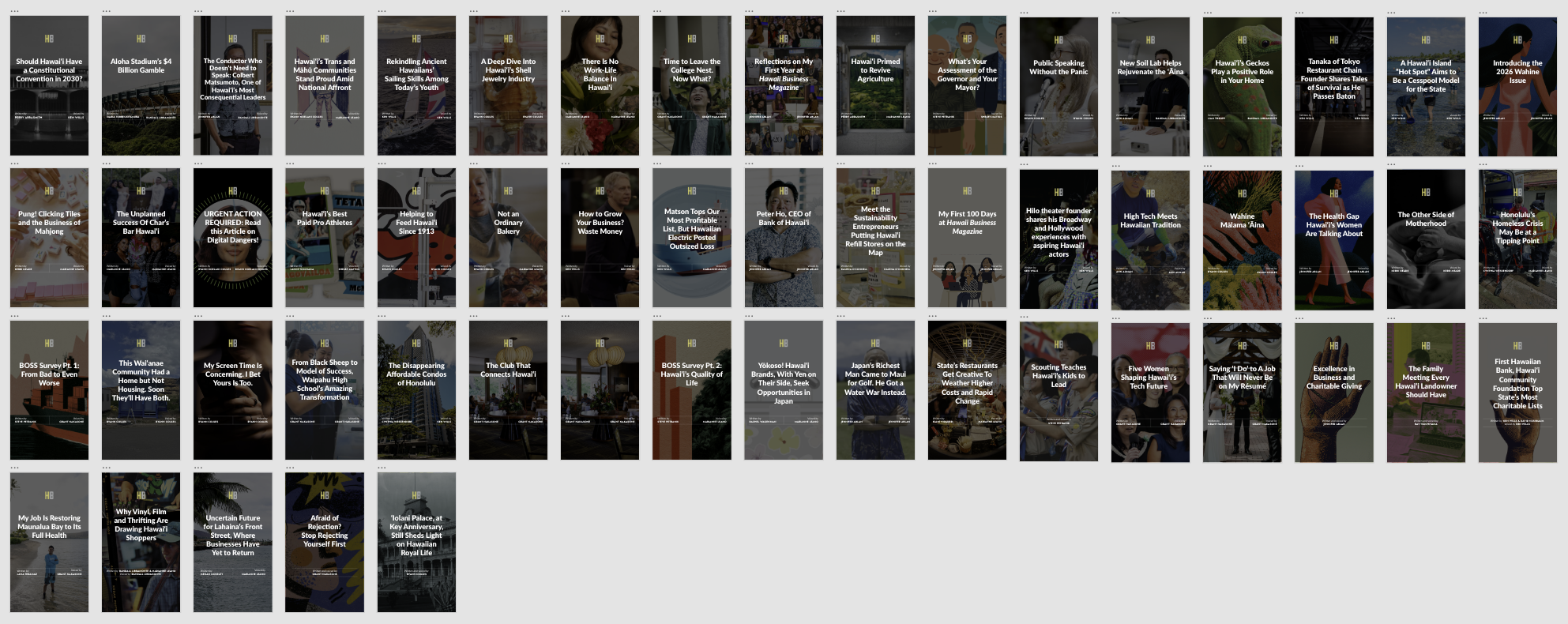
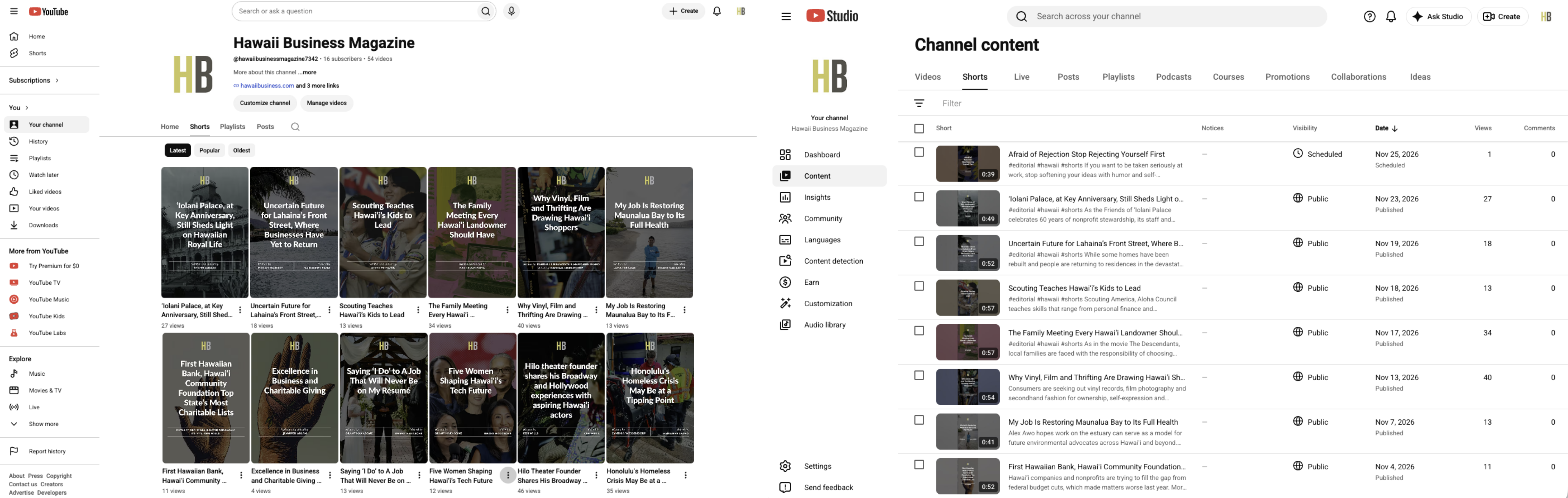
Collection of the Magazine-Read-Aloud (MRA) thumbnails with clear visibility of title
Turning an article into a 30–90-second video
We choose stories ahead of publication so there’s time to prepare a script and record the narration. The script starts with the full article, and every word in the read comes from the author. We developed an AI prompt to help us find a strong opening and select passages that flow together when spoken aloud. Which lines make the cut depends on the story. The goal is to give viewers enough context to understand it in one listen, with the full article there if they want to go deeper.
Our digital content manager coordinates the recordings and makes the first pass, cutting long pauses, mistakes, and retakes. The original writer often reads the piece, though sometimes one of us steps in. I’ve narrated a few myself, and the thumbnail cover identifies who wrote the story and who read it.
When I get the rough audio cut, I clean up the audio and tighten the pacing around the reader’s natural cadence. I transcribe the voiceover in Adobe Podcast and Adobe Premiere Pro, turn it into timed captions, and add royalty-free music that fits the story without getting in the way of the narration. The lead photo can carry the whole video. When our creative team has more photos or footage, I work them into the edit as B-roll.
I make the cover using a consistent layout that keeps the headline readable on our Instagram grid, with smaller credits for the author and narrator. Then I export the video, save it with the cover, and hand both files back to our digital content manager to schedule and publish.
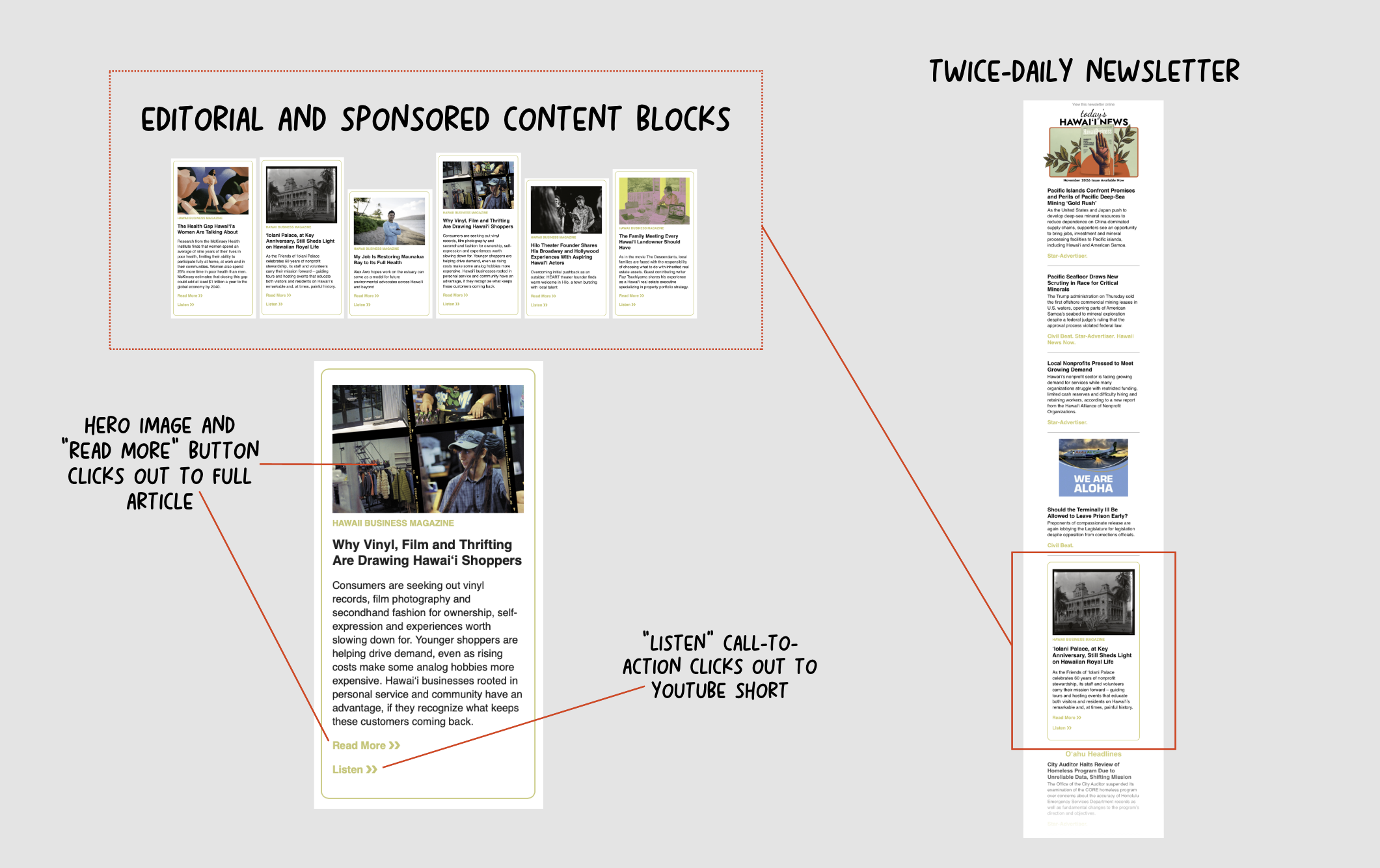
Besides our social media channels, our stories get visibility from being included in our twice-daily newsletter
Getting the videos in front of people
Instagram was the obvious place to start. We already had a much larger audience there than on YouTube, and we could publish a read-aloud in place of a static article announcement post. We kept the post copy short and pointed viewers to the full story through the link in our bio. On LinkedIn, we shared the same edit with our established audience in Hawaiʻi’s business community and included a direct link to the article.
Our newsletter also gave us a way to introduce readers to a YouTube channel we were still growing. We kept READ MORE as the link to the full article and added LISTEN just below it. That second button opened the YouTube Short, so subscribers could watch the Short even if they didn’t have an Instagram account.
When we posted the videos, we tagged the writers, narrators, interviewees, and businesses involved. That gave them visibility with our audience and a finished piece they could share with their own.
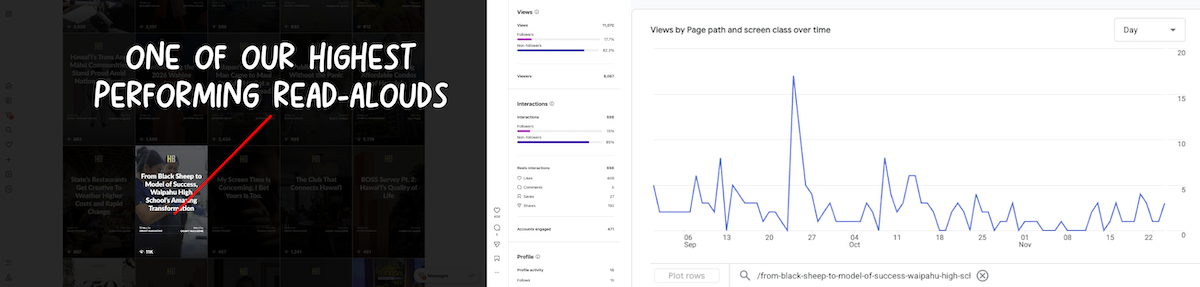
Traffic to the full written article aligns with when our read-aloud videos go viral, like our Waipahu High School story.
What changed and what we’re seeing so far
For selected stories, we can now have a narrated excerpt ready the day the article goes live. That gives us a video to share at launch and gives newsletter subscribers a choice in how they take in the story.
Our read-aloud about Waipahu High School was among our stronger performers on both Instagram Reels and YouTube Shorts. Other stories stood out on individual channels. The gecko story and the Waiʻanae community housing story did well on YouTube, while the Digital Analog and Motherhood stories were among our stronger Instagram posts. We’ve seen more breakout posts on Instagram so far, where we already have a larger audience.
We’re still learning what makes someone stop and watch or send a video to someone else. The topic and the delivery of the voiceover seem to matter. When a story features several people or businesses, tagging them gives each of them a chance to pass the video along to their own audience.
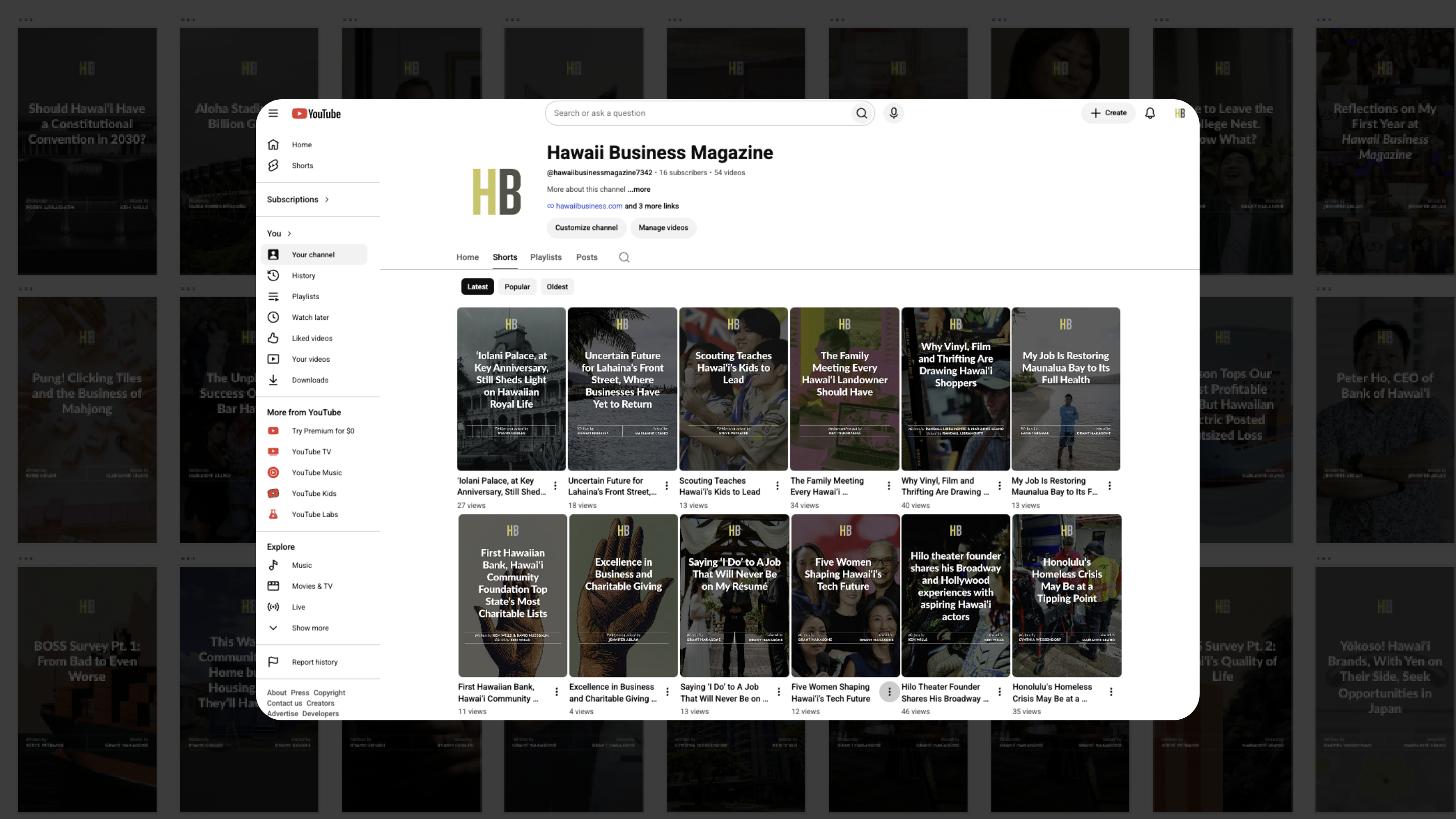
Front and back-end of our Youtube Channel
What it takes to monetize on YouTube
Adding LISTEN to our newsletter gave us a way to grow our YouTube audience. For that audience to become a source of ad revenue, the channel would need to qualify for the YouTube Partner Program’s revenue-sharing tier.
Ad and Premium revenue sharing (November 2026) 1,000 subscribers plus 4,000 public watch hours in 12 months or 10 million qualified Shorts views in 90 days.
Earlier access to fan funding and Shopping 500 subscribers, 3 public uploads in 90 days, and 3,000 public watch hours in 12 months or 3 million qualified Shorts views in 90 days.
New thresholds for applicants (February 1, 2027) 1,000 subscribers plus 8,000 public watch hours in 365 days or 20 million qualified Shorts views in 90 days.
Shorts qualify through engaged views, and Shorts Feed watch time is excluded from the watch-hour totals. Apply in YouTube Studio with two-step verification and a linked AdSense account. YouTube reviews your channel and requires it to stay active and follow its monetization policies.
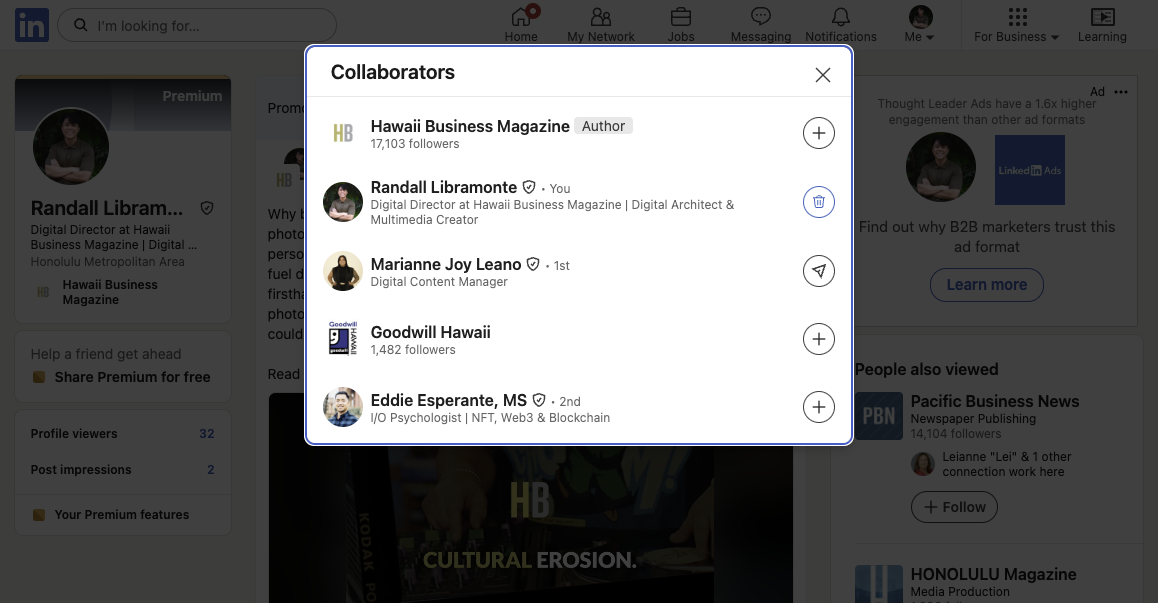
Linkedin's new collaborator feature - tagging all those involved in the project brings in more visibility and reach
Where the format could go next
So far, we’ve used Magazine Read-Alouds for our own editorial stories. I see a natural next step in offering a 30–90-second read-aloud as an add-on to a sponsored article. The sales team would have another option to offer, and the sponsor would get a finished video to share. A clear Sponsored by [brand] callout would identify the advertiser, and the post could point people to the full article and, where agreed, to the advertiser’s website. We could test the offer through Instagram, LinkedIn, and our newsletter while we continue growing on YouTube.
I’d also like to invite people from Hawaiʻi’s business community to read selected stories. A guest could participate on their own or represent a company, and we’d name and feature them across our channels. A sponsored appearance could have its own arrangement and clear attribution.
Full-length reads are another possibility, with a podcast-style feed as one potential home for the audio. The same production skills carry over to a longer piece: preparing the script for a spoken read, shaping the pace of the narration, and using the photos or footage we have to support the story.
A tool to truly focus in product design!
Lorem ipsum dolor sit amet consectetur adipiscing elit lobortis arcu enim praesent cursuse viverra sit semper lorem eu cursus vel hendrerit elementum morbi adipiscing ultrices
Neque sodales ut etiam sit amet nisl purus non tellus orci ac auctor
Adipiscing elit ut aliquam purus sit amet viverra suspendisse potenti
Sitamet justo donec enim diam porttitor lacus luctus accumsan tortor
Mauris commodo quis imperdiet massa tincidunt nunc pulvinar
Working with this tool can improve your design speed considerably
Vitae congue eu consequat ac felis placerat vestibulum lectus mauris ultrices cursus sit amet dictum sit amet justo donec enim diam porttitor lacus luctus accumsan tortor posuere praesent tristique magna sit amet purus gravida quis blandit turpis.
Adipiscing elit ut aliquam purus sit amet viverra suspendisse potenti
Key features of this tool that improve your process
At risus viverra adipiscing at in tellus integer feugiat nisl pretium fusce id velit ut tortor sagittis orci a scelerisque purus semper eget at lectus urna duis convallis. porta nibh venenatis cras sed felis eget neque laoreet suspendisse interdum consectetur libero:
Neque sodales ut etiam sit amet nisl purus non tellus orci ac auctor dolor
Adipiscing elit ut aliquam purus sit amet viverra suspendisse potenti consectur
Mauris commodo quis imperdiet massa tincidunt nunc pulvinar
Adipiscing elit ut aliquam purus sit amet viverra suspendisse potenti dolor sit
“Lorem ipsum dolor sit amet, consectetur adipiscing elit, sed do eiusmod tempor incididunt ut labore et dolore magna aliqua. Ut enim ad minim veniam”
Wrapping up: This is the best tool for design in 2023
Eget lorem dolor sed viverra ipsum nunc aliquet bibendum felis donec et pellentesque diam volutpat commodo sed egestas aliquam sem fringilla ut morbi tincidunt augue interdum velit euismod eu tincidunt tortor aliquam nulla
Is this tool free to use for everyone?
Nisi quis eleifend quam adipiscing vitae aliquet bibendum enim facilisis gravida neque. Velit euismod in pellentesque massa placerat volutpat lacus laoreet non curabitur gravida odio aenean sed adipiscing diam donec adipiscing tristique risus